Category: podcast

EP 526 The American Dream of Home Ownership Slipping Away From Many

EP 526 The American Dream of Home Ownership Slipping Away From Many

https://images.macmillan.com/folio-assets/macmillan_us_frontbookcovers_1000H/9781250804228.jpg


While much of what’s been written recently about housing in America are the exploding costs and great value of ownership, between 2010 and 2019, the number of renters in the country grew twice as fast as the homeowner population.  In fact, renters now make up a majority of residents in large American cities.  The cost of owning a home has been eating up household budgets and eclipsing the standard of thirty percent as the basis for what you should spending on housing a month.  A hidden factor in all of this is how much housing stock was gobbled up after the housing bubble of 2008 by banks, private equity firms, speculators and overseas money.  Their goal has been to maximize profit by renting or selling properties at inflated prices.  Our guest, Andrew Ross, author of ‘Sunset Blues’ lays out the conditions that have made the housing market so problematic for so many and why the American Dream is becoming unaffordable in many places. His book focuses on a particular area of central Florida to make his point, but our conversation discusses the failure of the housing market throughout urban and rural locales throughout the country.

EP 525 Are We on a Path to a Livable Future?

EP 525 Are We on a Path to a Livable Future?

https://m.media-amazon.com/images/I/519jrWh9FGS.jpg


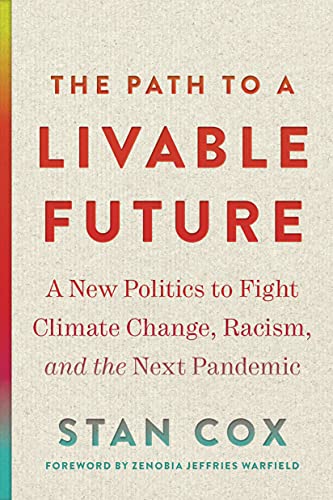
The last two years has demonstrated that unanticipated events, like a pandemic, can force drastic changes in the way that we live.  Climate science has been warning for decades now that we are on an unsustainable path and yet we seem incapable, or unwilling, to confront this reality.  More intense storms, raging wildfires, climate fluctuations and droughts have been dismissed by many as natural occurrences unaffected by human activity. The science says otherwise. So are we likely to make the necessary changes and can we do it it in time?  Our guest, Stan Cox, author of ‘The Path To a Livable Future’ questions whether the Green New Deal or the recent Glasgow summit on climate really address the sacrifices we need to make.  As long as America’s North Star continues to be the devotion to more and more economic growth the path he describes may lead to a ruinous end.  He discusses the need to deal with entangled emergencies, including climate change, racism and the next pandemic in this podcast.

EP 524 Key to Police Reform in America Rests in the Hands of Nine Jurors-the U.S. Supreme Court

EP 524 Key to Police Reform in America Rests in the Hands of Nine Jurors-the U.S. Supreme Court


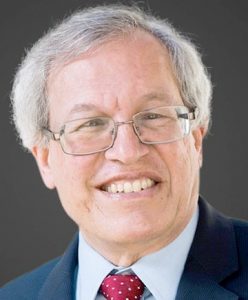
When you think about police reform and where the greatest responsibility for it rests, the institutions that come to mind are local governments, state governments and Congress.  Rarely does the U.S. Supreme Court and its role get much mention or discussion. The legal justification for things like stop and frisk, limits in bringing lawsuits to reform police departments and even the use of lethal choke holds rests with the Supreme Court.  Our guest documents a decades-long history of judicial failure in America, revealing how the Supreme Court has enabled racial profiling and intimidation and given legitimacy to law enforcement excesses that disproprtionately affect people of color.  Even though the Constitution clearly tries to limit police power, the Supreme Court rarely rules against police, according to Erwin Chemerinsky, Dean of the UC Berkeley School of Law and author of the book, ‘Presumed Guilty: How the Supreme Court Empowered the Police and Subverted Civil Rights’.  It’s an eye-opening discussion of this august body’s tipping of the scales of justice toward police excess.

EP 523 If There’s a Battle Between Democracy and Autocracy Why Are We Aiding the Enemy?

EP 523 If There’s a Battle Between Democracy and Autocracy Why Are We Aiding the Enemy?

                  Money talks in Washington DC and China and Russia sure have their attention. not  the voters  

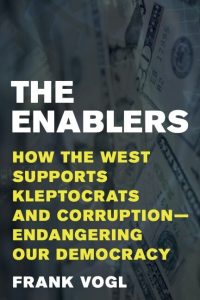
There exists a powerful lever the West can use to weaken authoritarian governments and stop the global backslide of democracy.  Why we choose not to use it speaks powerfully to the forces at play in our own society often blunting social and political reforms in favor of profits.  You see almost every authoritarian regime is a kleptocratic one and they rely on the Western financial system to launder and safeguard their billions.  We can–and must–rein in the white collar professionals, particularly bankers at places like Goldman Sachs, BNP, Deutsche Bank and HSBC, who are selling out democracy to get rich.  And we must address the issue of some Western politicians in league with them.  As Frank Vogl, a leader in global anti-corruption efforts, shows in his book, ‘The Enablers” How the West Supports Kleptocrats and Corruption–Endangering Our Democracy’, oligarchs and authoritarians could not reap the material benefits of plundering their countries without the help of bankers, lawyers, accountants and realtors in places like New York, London and other financial centers.  So if we want to weaken their political and financial power, we must act.  First, the public needs to understand what’s happening here.  This podcast is a start.

EP 522 Reinventing Death in the 21st Century

EP 522 Reinventing Death in the 21st Century


https://www.macfound.org/media/fellows/profile_photos/dawdy_2010_profile-240.jpg


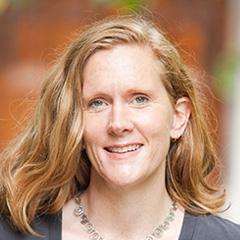
Death in America is undergoing a quiet revolution.  You now can have your body frozen, dissected, composted, dissolved or tanned.  Your family can incorporate your remains into jewelry, shotgun shells, paperweights and artwork.  Cremations have more than doubled and will reach nearly 70 percent by 2030.  As the grip of traditional religion is loosening on the culture, traditions of the past are giving way to DIY home funerals, personalized memorials and green burials. According to our guest, Shannon Lee Dawdy, the author of ‘American Afterlives: Reinventing Death in the 21st Century’, there have been more changes in the professional death industry in the last few decades than in the previous one hundred years.  Much of it stemming from our reaction to seeing death so vividly on 9-11, 2001.  Death is being reinvented simultaneously on three levels: disposition of human remains, new rituals and ideas about the afterlives.  It’s a fascinating discussion no one should avoid having about an issue we will all face regarding those closest to us and ourselves.

EP 521 China’s Rising and America Lacks Strategy to Contain

EP 521 China’s Rising and America Lacks Strategy to Contain

The unipolar superpower moment America had after the fall of the Soviet Union has ended without many of us sensing a peace dividend.  We are now returning to a period of great power competition, with our fiercest competitor being China.  The question before us is how to contain their growing economic and military ambitions before their ascendance is too far along to do accomplish peaceably.  Our guest, Elbridge Colby, who served as deputy assistant secretary of defense for strategy and force development from 2017 through 2018, led the development of America’s 2018 National Defense Strategy and is the author of ‘The Strategy of Denial: American Defense in an Age of Great Power Conflict’.  In it he lays out an approach the country should pursue, urging Americans to prepare for war, above all against China–precisely to deter it.  He feels we have a defense strategy that has had little intense focus on Asia, until this point, and that we have lost valuable time in the process.  While he sees the Biden Administration turning its attention to the region, in partnership with nations like Australia, India and Japan, he is concerned that the long view may not take into account threats that are more immediate, like China’s sights on Taiwan.  It’s a critically important, and timely, discussion.

EP 520 See the Future of the World by Looking at a Map

EP 520 See the Future of the World by Looking at a Map


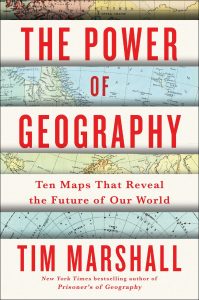
Some say geography is destiny.  While that may be too simplistic a way to look at the world, there is much you can tell about a nation’s fortunes based upon the neighborhood in which it resides.  Take the United States, for example.  We are isolated from potential aggressors, have unique positioning between two major oceans, and have an abundance of natural resources which allow us to be self sufficient, if necessary.  Other countries live in hostile, landlocked situations which have made them vulnerable to attack and re-shaping over centuries.  And, of course, your geography provides great the key to how you will fare in the competition for vital natural resources and in an era of climate change.  We will walk you through the flashpoints in today’s world with Tim Marshall, author of ‘The Power of Geography:Ten Maps That Reveal the Future of Our World’.  He has a fascinating take on what to look for as we take a spin around the globe on today’s podcast.

EP 519 Is Operation Warp Speed a Template for Future Pandemics?

EP 519 Is Operation Warp Speed a Template for Future Pandemics?


There is much confusion as to how a new technology could have been developed so quickly in response to a novel coronavirus which came to be known as COVID-19.  The truth is that the messenger RNA technology was in the works for decades and that the release of the sequence of the new coronavirus from a brave physician in China gave vacciane scientists, virologists and government officials what they needed to make the unprecedented push to bring vaccines to market in record time.  It’s a compelling story as told by our guest, Brendan Borrell, in his book, ‘The First Shots’.  You will learn not only about gene sequencing, but about the sequence of events and the colorful cast of characters racing to save the planet from even greater devastation than the virus has caused.  People like Dr. Barney Graham, Jason McClellan, Kizzmekia Corbett and Dr. Robert Kadlec are acknowledged for their work which was critical to this effort.  And the work is in no way done.  Just as anti-viral pills are being developed for market by Merck and Pfizer, many across the globe are banking on faster, more scalable vaccines in places, like Africa, where so few are yet vaccinated.  These involve different technologies than the mRNA. There are many viruses which we lack sufficient information about just waiting for their moment to affect the human population. The lessons from this pandemic must be applied to those enemies of mankind.  Hopefully, we have learned from our successes and failures in response to this outbreak.


EP 518 Legacy of America’s Stolen Lands and Attempts at Reconciliation

EP 518 Legacy of America’s Stolen Lands and Attempts at Reconciliation


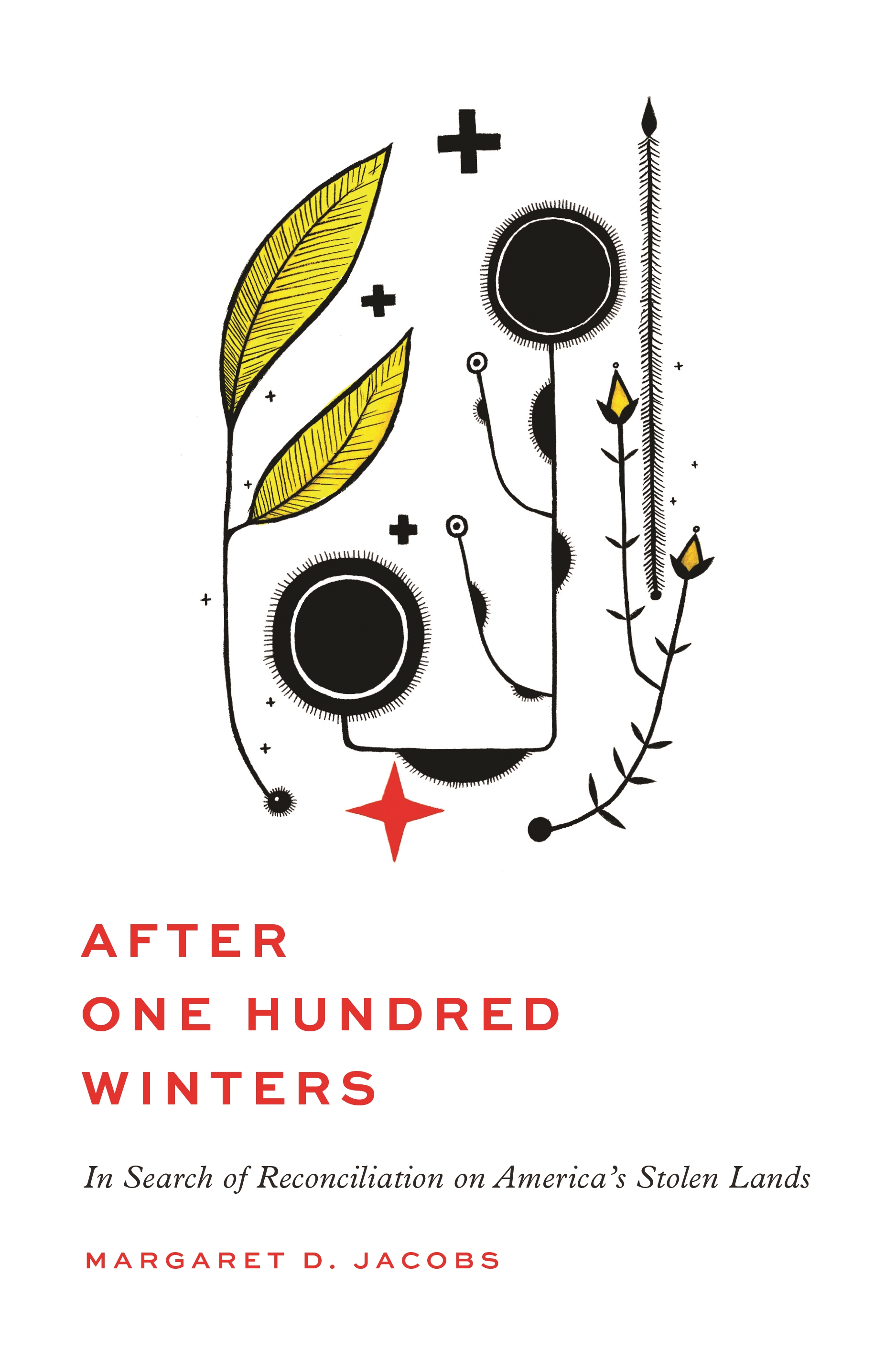
In this podcast, we wonder aloud as to whether America has even to this day confronted the harsh truth that the country we know today was founded on the violent dispossession of Indigenous people.  While we seem to be having a moment of reckoning as it relates to the issue of slavery and its impact on African-Americans, how must Native peoples feel as there is barely a mention of the legacy of massacres and removal from their lands centuries back.  Native peoples are resilient as their sheer existence proves, and their spirit indomitable, but have we, the settlers, really come to terms with our actions?  Margaret Jacobs, a professor of history and director of the Center for Great Plains Studies at the University of Nebraska-Lincoln, in her book ‘After One Hundred Winters’ tells stories of the individuals and communities who are working together to heal historical wounds.  She reveals how much can be gained by learning from our history instead of denying it.  As a settler historian she tries help her readers come to terms with our inaction toward Indigenous people, including the absence of a Truth and Reconciliation Commission to finally set the record straight about a history many find too painful to unwind even with the passage of time. Can ordinary people do it alone or does our society have to have a true reckoning?  This podcast may help you sort out your own thoughts on the subject.


EP 517 Are You a Part of the 9.9 Percenters In America?

EP 517 Are You a Part of the 9.9 Percenters In America?


In the past, there was a mythology built around the concept of the millionaire next door.  It was the assuming couple who brought little attention to themselves.  They didn’t drive flashy cars or exhibit a taste for bling.  As two-income professionals, however, they had a nice home and learned the lessons of compound interest early on.  Today, in aggregate, they make up the group with the most wealth in America.  And while we often talk about the excesses of the 0.1 percent, perhaps we have given too much of a free ride to those right below them who have plenty of assets when totalled up but see nothing in their lifestyle that creates the inequities that the other ninety percent are feeling.  In many cases, they fail to recognize the many ‘invisible’ benefits that society offers those in this group. Philosopher Matthew Stewart, author of ‘The 9.9 Percent: The New Aristrocacy That Is Entrenching Inequality and Warping Our Culture’, joins us to discuss this key sub-set in our culture.  By the end of the podcast, you will determine if the label applies to you.