EP 605 Afghan Interpreter on American Promises Betrayed
 We watched it on television. He lived it daily for years as an Afghanistan military interpreter and as a desperate husband and father trying to board a flight out of the country with is family as Kabul fell into a sea of panic and chaos. We are still shaken by what we saw. He found the resolve to resettle his immediate family in the United States, continue to pursue an exit for others left behind and write a book detailing his highly informed and complex opinions of what happened. Jamil Hassan is the extraordinary person who wrote the book, “Promises Betrayed: An Afghan Interpreter at the Fall of Kabul”. He freely expresses his concerns about American policy, our visa system and the future of his country.
Podcast: Play in new window | Download
 In your mind have you placed the fracturing of America’s politics at the entrance way to America’s college system? It takes some mental gymnastics to get there but if you trace the trajectory of American higher education from the postwar boom of the GI bill after World War II and the optimism for all to today’s divisiveness, while one group goes into crippling debt to obtain a credential that society places a high value on while those who lack a degree often distrust and even revile them, but have no viable path to a hopeful future( search deaths of despair). A de industrialized America has shattered their hopes to attain The American Dream. The worlds and fortunes of these groups seem miles apart and have been exacerbated by politicians taking advantage of the divides to discount the value of a degree and the expertise it often represents. Welcome to America 2022. Will Bunch, a Pulitzer Prize winner, details this trajectory and its implications in his new book ‘After the Ivory Tower Falls’. He joins us to discuss the issues and solutions.
 President Biden recently announced a college loan forgiveness program. It provides forgiving up to $10,000 of student debt for up to 43 million low to middle income borrowers. That is single borrowers with incomes of up to $125,000 and couples with incomes up to $250,000. It will also forgive as much as $20,000 for the lowest income borrowers who qualified for Pell Grants to pay for college. To some this is too little given the staggering $1.7 trillion in outstanding loans. To others, it is a giveaway to likely Democratic voters—young, college educated people and will be paid for by many who never went to college in the first place. All agree it does nothing to deal with inherent problems that make college education so debt inducing in the first place. We discuss all the angles today with Steven Brint, Ph.D. a distinguished professor of sociology and public policy at the University of California, Riverside.
 Dictatorships do not come about in all the same way. The origin story, it turns out, is more than something interesting to read in a history book. Revolutionary autocracies, those born of violent social revolution, are extraordinarily durable. China, Cuba, Iran and Vietnam could be counted among this number. The record indicates that over seventy percent of these regimes have lasted thirty years or more. Why should we care? They are also highly consequential in international affairs and conflicts around the globe. Most of us can remember the Cuban Missile Crisis, the Iranian hostage situation and the Vietnam War as among the high profile engagements involving these autocracies. How do these regimes persist in the face of many challenges–economic, political and in the international arena? That’s the question that Steven Levitsky and, our guest, Lucan Way, attempt to explain in their book “Revolution and Dictatorship: The Violent Origins of Durable Authoritarianism”. It is an important question for the United States which has seen some of its greatest foreign policy blunders take place in conjunction with these regimes.
 While rejoining the Paris Agreement on climate might make us feel better, diplomacy is not enough to fix our growing problems. On this podcast, David Victor of the University of California, San Diego joins us. He, along with Charles Sabel, of Columbia Law School, have written the book, “Fixing the Climate: Strategies for an Uncertain World.” In order to decarbonize the economy, they say we must integrate bottom-up, local experimentation with top-down, global cooperation. A model for what they envision can be found by going back to the late 1980’s and examining the ‘experimentalist governance’ approach used to address the depletion of the ozone layer through the Montreal Protocols. Experimentalist governance involves creativity and innovation in all sectors, at every level. It is neither top-down, like a hierarchy, nor bottom-up, like self-governing group. It’s a set of disruptive innovations that break through current interests and reveal whole new approaches to dealing with the issue. The good news is much of this is going on today, but the harder question to answer is whether it will all come together in time to spare mankind and the planet the worst impacts.
 Given that COVID-19 has been with us for a relatively short period of time, as viruses go, it’s hard to say whether the after effects that some people experience are short term or will become chronic. That’s why many scientists around the world are studying it now. The conditions related to it are as diverse as the populations it affects, young and old, all races, over continents. We often hear of neurological symptoms, brain fog, fatigue and shortness of breath. Depending upon how your health was before you contracted COVID, it’s hard to deduce whether any of these are due to the overall state of your health or the lingering reminders that you’ve been visited by the pandemic. There is no test to diagnose post-COVID conditions and there is no drug or therapy to make them go away. Given all this, there’s still a lot to talk about with Dr. Steven Deeks, a professor of medicine at the University of California and principal investigator of the Long -Term Impact of Infection with Novel Coronavirus(LIINC)study. While vaccines are helpful in mitigating the worst effects of COVID, there is a growing desire not to contract the new, more transmissible variants expressly to avoid what we know so little about–post COVID conditions.
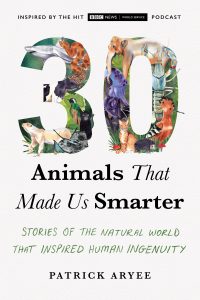 How you heard of the field of bio mimicry? It’s a relatively new scientific field in which innovations inspired by the natural world enrich our lives every day and, in some cases, help save them. Let’s take one example among the many described on the podcast. Take kingfishers for example: the design of their beaks allows the birds to plunge head-first into the water at speeds nearing 25 miles per hour without damage. These unique beaks helped improve millions of Japanese people’s daily commutes when an engineer used them as inspiration for designing a faster, quieter, and more powerful bullet train. Termites, mosquitoes, elephants and other creatures, including our own dogs, when observed by keen scientific minds can unlock fascinating advances for humankind. Patrick Aryee, our guest, and the author of “30 Animals That Made Us Smarter: Stories of the Natural World That Inspired Human Ingenuity” joins us to explain how the harsh conditions around the globe, requiring animal adaptation, has become a scientific tool of great importance in unlocking the keys to many benefits for all of us.
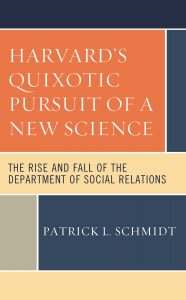 While little known, Harvard University tried a grand experiment starting in the 1940’s as it merged parts of the psychology department with the anthropology and sociology departments into a construct known as the Department of Social Relations. This interdisciplinary approach was meant to help unlock why we humans behave as we do. It made the audacious claim that it would surpass in importance Harvard’s “big three” disciplines of economics, government, and history. And while the tools and the scholars were put in place, there was much fractiousness among the faculty, a lack of collegiality and no overarching theory to under gird the effort. It did produce scholarly work and trained many notable graduates. Perhaps as we look at the boom today in the field of psychedelic drugs, which are being legalized in many states to treat various conditions, like PTSD and depression, and for recreational use, perhaps this Department will be best remembered for Timothy Leary’s experimentation with the psychedelic drug psilocybin. This was a forerunner to the counterculture movement of the 1960’s. All this history is included in our guest Patrick Schmidt’s new book “Harvard’s Quixotic Pursuit of a New Science: The Rise and Fall of the Department of Social Relations”.
 Much attention is paid to mass shootings because they often involve our most precious citizens, our children. Yet, other forms of gun violence such as that between intimate partners, that associated with drugs on city streets and that which involves self harm and suicide get far less. America’s fascination with the gun goes unabated as tepid laws are passed, government study of the issues surrounding it go unfunded and the US Supreme Court strengthens Second Amendment protections with little regard for the 21st century technology and impacts. While it was my intent to focus on mass shootings in this podcast, our guest criminologist Emma Fridel, PhD, of Florida State University quickly moved the conversation to the range of topics that get less attention, yet daily result in the upending and actual ending of lives, as well. It is a lively discussion of a range of issues relating to gun-related violence in our culture, touching on law, politics and attitudes.
 It seems like the oldest false start in the world as a rumor swirls that a local mall is closing. Sometimes, they do. More times than not they are re-created to serve new, and often, public purposes, like libraries, museums and community event spaces. From Victor Gruen’s Southdale Shopping Center–America’s first indoor mall–which opened in 1956 near Minneapolis we have seen an evolution in what malls look like, the amenities within and the purpose. At first, it was functional. Let’s get in and out once we find this item or that. Then it became experiential as we had our first crush, date or ice cream lalapoolaza there. Alexandra Lange, one of America’s leading design critics, and author of “Meet Me by the Fountain: An Inside History of the Mall”, put her estimable skills to defining the form and function of malls over the years and their story of constant re-invention. First a suburban phenomenon needed to create a faux public square to fascinating interpretations of charming restoration in urban centers like Boston’s Faneuil Hall. And that re-imagining continues to this day as on-line shopping and big box stores force mall owners to consider their future in this fast changing retail environment.