EP 575 The Pandemic Brought on Government Lies and Censorship
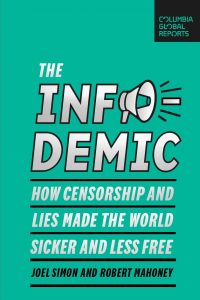 The most enduring legacy of COVID may be how governments around the world used it as cover to undermine freedom, subvert the flow of information and establish ways of avoiding accountability that will outlast the pandemic itself. The United States federal government tried to flood the zone with questionable theories about how to deal with the pandemic and when and how it would affect the nation. Never was there a robust effort to provide transparency and persuasion to lead us through a novel public health crisis by bringing us together as a society. Other democracies did a much better job of rallying their people to the sacrifices required and autocracies used techniques like China’s ‘just in time censorship’ and Russia’s more aggressive lock down of the political opposition in the name of public health. In the compelling new book, “The Infodemic: How Censorship and Lies Made the World Sicker and Less Free”, Joel Simon and our guest, Robert Mahoney, take us on an international journey exploring government communications practices in the face of this health emergency. Their book is part of the Columbia Global Reports project.
Podcast: Play in new window | Download
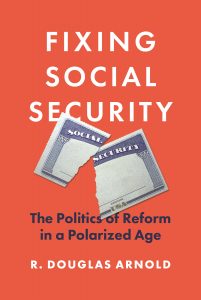 The future solvency of Social Security hangs in the balance by decisions that lawmakers in Washington will have to make over the next decade. While many of us might think that Social Security’s solvency is fungible–just move some pots around–that’s not how the system was set up. It’s pay as you go using only funds being contributed by current workers and that which has accumulated in the Social Security Trust Fund. Thanks to changes made 40 years ago on both the benefits and revenue side, the system has been in good shape for the last 40 years. However, given the long-living baby boom generation and the smaller group of American workers, the trust fund is expected to be depleted by 2034 and reliance only on current contributions will require a 21 percent cut to those enrolled in the program. R. Douglas Arnold, author of ‘Fixing Social Security: The Politics of Reform in a Polarized Age’ has a hard time imagining that a fix will not be found, thus avoiding the political wrath of 83 million recipients, but like many things in our nation’s capital it will be a compromise perhaps at the eleventh hour. It’s an important conversation on today’s podcast.
 Ken Dychtwald, the founder of Age Wave, is a force of nature who through his writings and talks has changed America’s way of looking at aging. In this podcast, he employs his remarkable communication skills to frame the issues of aging in a new light and delivers results from a new study regarding changing retirement patterns. This study explores retirement in a new light, one that looks at it from the perspective of a 20 to 30 year life stage. It uncovers the birth of a new retirement journey, explores how it unfolds, and reveals four unique stages each with new dreams, worries, choices, and planning needs. Are you a purposeful pathfinder: Perhaps a relaxed traditionalist? Maybe you’re part of the group he deems ‘challenged yet hopefuls’ or a ‘regretful struggler’. He urges those approaching retirement to be purposeful and take early action in order to successfully navigate the retirement journey. He is riveting and the material fresh and important.
 In the United States we are used to single-member districts for our House of Representatives. These are winner take all style elections. This approach seems so natural to us. You lose by one vote and you’re gone. A proportional representative approach, which is practiced in most democracies, involves larger multi-member districts and a division of seats by the percentage of the votes. If there are 100 votes cast and one party gets 60 of them, they get three fifths of the seats. This method may unlock the two party doom loop which has made American democracy so divided and ossified. Nothing gets done. With more parties and more shades of representation it is less us versus them and requires that parties come more to the middle to do the people’s business. Will it ever happen in America? Yes if fixourhouse.org is successful in its efforts. You probably haven’t heard much yet about this movement, but it is an interesting alternative to business as usual. Eli Zupnick, the group’s founder, joins us to explain.
 The field of public relations has been most simply described as ‘doing good and communicating it’. Even in days when newspapers, television and radio were the prime sources of information, a skilled public relations practitioner would have to work hard for placement, by having a great understanding as to what the media outlet was looking for and being creative in pitching the content. Today with the emergence of social media the tools of the trade are vastly expanded and complicated as clients want their content to ‘go viral’, whatever that means. The noise and the fractionalization of the market means meeting expectations regarding impacts that are wholly unrealistic. And, at its most practical, the value assigned to publicity is ephemeral. To discuss this nuanced subject is Freda Drake, author of ‘Publicity on Steroids’. You will gain a great understanding of what it takes to get a message out in this new age of mass, and niche, communication.
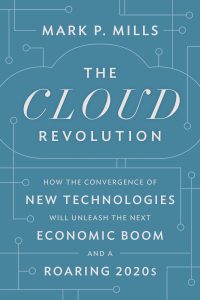 In these complicated economic times it’s easy to miss the forest amidst the trees. Just as basic telephony gave way to smart telephony, which now resides in all of our pockets and has revolutionized the way we communicate and do e-commerce, our guest, Mark Mills, author of ‘The Cloud Revolution’ directs our thinking to the fact that the next positive revolution we will experience is invisible, but more impactful than anything we’ve seen to date. And it’s all in the cloud, ready to fundamentally change how we share and process information. The infrastructure is being built all around the globe in huge warehouse like data centers which will change business relationships and spawn incredible economic growth for the planet. His hopefulness is grounded in historical precedent and will lead to a condition economically that will lift all boats. Any still floating aimlessly offshore will find greater help from coffers filled with public monies to address any issues owing to disruption. It is an incredible book and gives us hope that the roaring 20’s we soon will refer to are the 2020’s. I say anytime now.
 Our guest, Howard Husock, author of ‘The Poor Side of Town and Why We Need It’, has a warm spot for what he considers ‘naturally occurring affordable housing’, the kind that used to be available to those who were finding their way in this country as they went from an apartment to a starter home and beyond. For a host of reasons that we discuss and that he covers in his book, he describes housing policy throughout the years and what remains today in a market that is hostile to millions looking for the first or second rung on the ladder, in communities that provide for a range of services and options. Tenements, projects, subsidized housing and new up zoning efforts are all discussed. Clearly, we have an affordable housing problem in this country, as evidenced by any number of measures. The question is how do we best get more of it onto the market. That’s our topic today.
 It’s likely that when you see double digit increases in the price of food, energy and other essentials, you are in a state of inflation. As anyone who uses our currency, in whatever fashion knows, that’s the place we find ourselves today. It’s having a major impact on household budgets and causing reactions in markets and in federal monetary policy. Harder to determine is what are the factors that brought it on and what you do about it to bring those inflation numbers down. Our guest, Nathan Lewis has co-authored a book with Steve Forbes and Elizabeth Ames, called ‘Inflation: What It Is, Why It’s Bad, and How To Fix It’. They attribute our present circumstance to the massive amount of money created out of thin air by the Federal Reserve in the wake of the housing crash in 2009 and in response to the COVID-19 emergency in recent years. In their view that has significantly weakened the value of the dollar. Others say that supply chain issues and the quicker than anticipated rate of recovery have overheated the economy. In any event, as impactful as inflation is the dollar is still king among all currencies and borrowers still buy U.S. debt. Our discussion got to the hottest topic in financial circles: Modern Monetary Theory. You need to be aware of what it is, agree or disagree with it.