EP 597 Worst of Our Gun Related Violence Gets Little Attention
 Much attention is paid to mass shootings because they often involve our most precious citizens, our children. Yet, other forms of gun violence such as that between intimate partners, that associated with drugs on city streets and that which involves self harm and suicide get far less. America’s fascination with the gun goes unabated as tepid laws are passed, government study of the issues surrounding it go unfunded and the US Supreme Court strengthens Second Amendment protections with little regard for the 21st century technology and impacts. While it was my intent to focus on mass shootings in this podcast, our guest criminologist Emma Fridel, PhD, of Florida State University quickly moved the conversation to the range of topics that get less attention, yet daily result in the upending and actual ending of lives, as well. It is a lively discussion of a range of issues relating to gun-related violence in our culture, touching on law, politics and attitudes.
Podcast: Play in new window | Download
 It seems like the oldest false start in the world as a rumor swirls that a local mall is closing. Sometimes, they do. More times than not they are re-created to serve new, and often, public purposes, like libraries, museums and community event spaces. From Victor Gruen’s Southdale Shopping Center–America’s first indoor mall–which opened in 1956 near Minneapolis we have seen an evolution in what malls look like, the amenities within and the purpose. At first, it was functional. Let’s get in and out once we find this item or that. Then it became experiential as we had our first crush, date or ice cream lalapoolaza there. Alexandra Lange, one of America’s leading design critics, and author of “Meet Me by the Fountain: An Inside History of the Mall”, put her estimable skills to defining the form and function of malls over the years and their story of constant re-invention. First a suburban phenomenon needed to create a faux public square to fascinating interpretations of charming restoration in urban centers like Boston’s Faneuil Hall. And that re-imagining continues to this day as on-line shopping and big box stores force mall owners to consider their future in this fast changing retail environment.
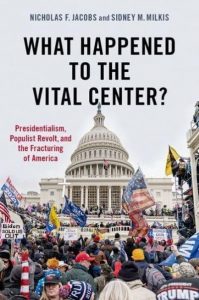 That’s the question posed by our guest in his new book and on this podcast. The notion of a vital center in American politics has been a subject of inquiry for many years, going back to Arthur Schlesinger, Jr.’s 1949 book “The Vital Center”. This idea of all of us coalescing around solutions that are sensible is hard to argue with. Unfortunately, as we see today, the ideal is far from being realized. The real question is: why? In the book “What Happened to the Vital Center: Presidentialism, Populist Revolt, and the Fracturing of America”, our guest, Nicholas Jacobs and his co-author, Sidney Milkis, attribute much of the problem to the hollowing out of the party structures today. They have been replaced by interest group operatives and single-issue advocates. Coupled with the ever increasing powers of Office of the President and the many responsibilities now handled within, the role of the parties in constructing competing visions of the future to put before the voters has been replaced by actors not concerned with this steadying process. Republicans in 2020 had no platform. It was whatever Donald Trump wanted. And Democrats had a range of ideas from moderate to very progressive and settled on a candidate who was most likely to beat Trump, not set out a bold vision of his party for America.
 James Madison conceived of the states in our federalist system as being laboratories for democracy where policy innovations can take place. In an era when Congress has become more gridlocked and the parties more rigid ideologically, national partisan and activist groups, often one issue constituencies, have trained their sights on state legislatures, nationalizing state politics in the process and making the state legislatures hotbeds of red and blue disputes, including abortion, guns, health care, climate change and election administration. In his new book, “Laboratories Against Democracy”, Jacob Grumbach traces how national groups are using state governmental authority to suppress the vote, gerrymander districts, and erode the very foundations of democracy itself.
 There is a lot of literature about the sacrifices that professional women make when choosing to have a family. Much has also been written about single moms and their travails. Our guest is exploring new territory as she zeroes in on working class young people and their approaches to caring for a baby while also needing to work at jobs that in general do not give them much, if any, flexibility. This cohort represents the largest group of young parents in our country. These are the essential front-line workers who have little autonomy in the workplace and have few government benefits that are of great value. What good is family leave when it’s only for a twelve week duration and without pay? These are the people generally working paycheck to paycheck, like a majority of Americans. Maureen Perry-Jenkins, a psychology professor at the University of Massachusetts, Amherst, is the author of “Work Matters: How Parents’ Jobs Shape Children’s Well-Being”. These young parents each have different stories. Some are doing well. Others just getting by with the help of family and friends and great determination. You will be moved by their stories and come away with a much greater appreciation for how their work intersects with their most important job–raising that newborn child.
 Discrimination has reared its ugly head in America in so many institutions that it’s remarkable that some people still balk at the term ‘institutional racism’. Case in point: the National Football League. For years in the earlier part of the century black players were not allowed to compete at all. Then as pioneers in ownership and management began recruiting black players, the prejudice against a black man playing the coveted position of quarterback continued. The rap was that they lacked the intelligence and leadership qualities that made the quarterback the most important position in team sports. Even if they played the position in college, generally in the pros they were converted into wide receivers or safety backs. While they may have been the best athletes on the team, they lacked another attribute: whiteness. Today, that is all changing as the black quarterback, strong of leg and arm, is now succeeding in ways previously imagined. The names Patrick Mahomes, Kyler Murray, Lamar Jackson and Dak Prescott are paving a new frontier which will likely result in African-Americans accounting for half or more the pro quarterbacks in the period ahead. Jason Reid, senior NFL sports writer at Andscape, an ESPN platform, and author of “Rise of the Black Quarterback”, joins us to discuss.
 This ain’t Ronald Reagan’s conservative GOP. He favored immigration, international involvement and free trade. So what does the Trump era conservative movement resemble? Calivin Coolidge? Perhaps, the two have little in common personally, but from a policy perspective economic protection, restricted immigration and non-intervention in the world, including mutual defense alliances are back in the conservative playbook. Above all, the Trump era is defined by pushing back against the left’s attempts to refocus American society on the expansion of rights for minorities and women. This threat as perceived by many high school educated white voters and those in rural precincts was no better symbolized that the ascendance of Barack Obama to The White House in 2008. The right in America traditionally has acted as the clean up crew for Democratic Party’s excesses. In that interpretation of recent American history, America’s federal government is clearly a reflection of the Democratic Party’s big ideas, including Social Security, Medicare and Obamacare. So, does this group of leaders on the right really want to govern? And, if so, to do what? Joining us to discuss this topic is Matthew Continetti, author of “The Right: The Hundred Year War for American Conservatism”.
 Remember the Alanis Morrisette song, “Isn’t It Ironic”, well that fits the notion of trying to reform gun laws in America. On virtually the same day as Congress passed a series of measures, not curtailing the types of guns available on America’s streets or universal background checks, but modest measures to help cut back on the routine assault on children and others across the country by those using guns, the U.S. Supreme Court in the decision in New York Rifle and Pisol vs. Bruen case elevated the Second Amendment to a position in which regulation of this protected and prescribed activity will become that much harder over time. The Supreme Court’s actions will insure that many states which have strict gun laws, like New York and California, will have challenges put forward to these measures. Joining us for a textured conversation on a complicated, historically significant issue is Joseph Blocher, a professor of Law and co-director of the Center for Firearms Law at Duke University. He’s terrific.
 While artificial intelligence is remarkable(right, Alexa?) it is a stretch to believe the science fiction portrayals of future humans being replaced by artificial intelligence is likely…ever. The key reason, according to our guest on this podcast, is because artificial intelligence is based on algorithms and algorithms are mathematical in nature, requiring a human to program the robots to do stuff. Despite a Google engineer’s recent representation that what the company was working on was a sentient robot, that just does not seem possible. He was fired recently, by the way. And while there is an AI church forming a cult religion around this subject, there are aspects of human intelligence, things for example that composers, painters and novelists do, that will never be replicated by a machine, even one programmed by the smartest engineers in the world. Our guest, Robert J. Marks II is a distinguished professor of Engineering at Baylor University. He has worked in the field of artificial research for more than three decades. In his book “Non-Computable You: What You Do That Artificial Intelligence Never Will” he separates the exciting possibilities for artificial intelligence, from heady claims that are provably overblown. It’s a fascinating topic and a compelling listen.
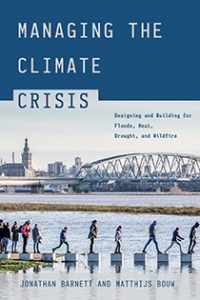 : In 2021, the United States experienced 20 weather and climate disasters, each costing more than a billion dollars to repair. As we wait for world leaders to engage their citizens in an honest conversation about how perilous our current course is, we all must take actions to get us through the next thirty years. Without any question, in this time frame we will continue to see seven major climate-related threats facing the United States: flooding along coastlines, river flooding, flash floods, drought, high heat, wildfires and food shortages. Our guest makes a compelling case that actionable policies that address all types of climate disasters are urgently needed to protect people’s lives and livelihoods. In their book, “Managing the Climate Crisis: Designing and Building for Floods, Heat, Drought, and Wildfire”, design and planning experts Matthijs Bouw and our guest, Jonathan Barnett show how communities can use a combination of engineered and nature-based solutions to deal with the constellation of problems caused by trapped greenhouse gases. While I press for a more concerted international policy response, our guest continues to come back to take steps now in our homes, cities and states before matters get much worse. And they are already worse than most people want to admit.