EP 143 It’s Better Than It Looks
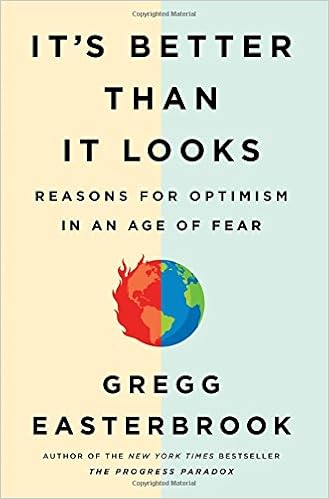 FDR reminded us of this many years ago. And, according to author Gregg Easterbrook it’s never being truer than today. So while we dwell on small details the big picture for the world is that whatever indices you use–disease, poverty, resource depletion, crime, food supply, world war–the world has never been better off. Mr. Easterbrook admits that inequality and climate change remain challenges, but, in his mind, more easily overcome against this backdrop of improving conditions around the globe. It’s an optimist’s view of the human condition and a welcome change from 24/7 misery many are selling. His thesis is ‘It’s Better Than it Looks’. Cheer up and listen.
Podcast: Play in new window | Download
 Astronomist, David Weintraub, completes our mini-series on current space exploits by explaining the historical fascination with the red planet and present day efforts to get there in his book ‘Life on Mars: What to Know Before You Go’. It’s all the rage and the pioneers are lining up to jump aboard the first manned spaceship going that way. Would you? Consider this: it’s a risk in going, will take about six months transit and there’s no need to buy a round trip ticket. Oh, I forgot to say, that there’s no oxygen, just carbon dioxide, so no need to bring clothes because you’ll be walking around in that spacesuit for the foreseeable future. And, if there’s no doctor on the journey, well….It’s still fascinating to contemplate as we do on this episode.
 With the term being bandied about as a weapon of mass distraction, you probably are confused by what the term ‘fake news’ really means. It’s for that reason that America Trends brings you a two-part series culled from a panel discussion which Larry Rifkin moderated in Connecticut recently. The panel included three Pulitzer Prize-winning journalists. The event was put on by Connecticut Humanities and involved Capital Community College of Hartford. Production services were provided by Middlesex Community College’s Corporate Media Center, based in Middletown, Connecticut. The panelists are McIntire of the New York Times, Gina Seay, former senior editor of the Hartford Courant, Steven G. Smith, photojournalist and professor at the University of Connecticut(U Conn) and Mike Stanton, another U Conn professor. More of their backgrounds are provided in the introductions.
 ‘What gets measured gets done’, according to management experts like Tom Peters. But does it get done at the expense of other–more important–things? That’s the central question of the book ‘The Tyranny of Metrics’ by Jerry Z. Muller. He joins us for a discussion of whether all goods and services in our society can be quantified and whether that’s the best use of precious time. For example, is the new tendency in public education to teach to the test enhancing learning or simply a way to limit the evaluation of students and teachers to a number when society may benefit from a much more robust measure of readiness. Central to the issue is whether using numbers as the predominant indicator assures that they will be manipulated in some way. Take a listen.
 Recently, when the U.S. Supreme Court declared the federal ban on sports betting unconstitutional and repealed the Professional and Amateur Sports Protection Act, it opened the floodgates for any state to legalize sports betting. On the heels of this decision, America Trends got busy in finding out what this might suggest for the future for our society. The normalizing and legalizing of any such activity has social impacts. In this blended podcast, we turn to Keith Whyte, executive director of the National Council on Problem Gambling, Arnie Wexler, co-author of ‘All Bets Are Off’ and Daniel Simone, an expert on mob activities in America, to get their unique perspectives on what happens next.
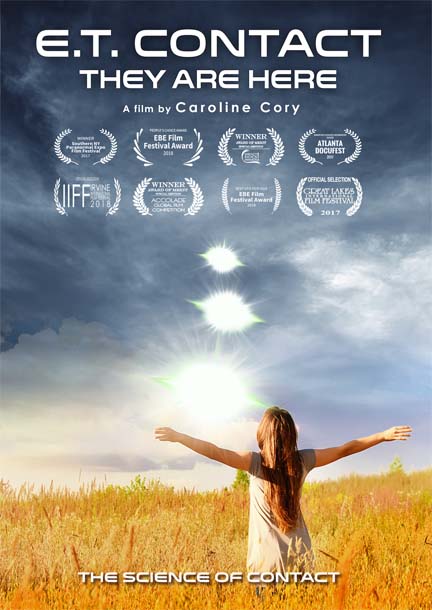 Do you believe in extraterrestrial beings and contacts from deep space? Or are you just awakening to more openness about issues of higher consciousness? If you’re like many Americans you’re becoming much more accepting of phenomena previously considered unusual and little spoken of. Producer and director Caroline Cory has just made a film, titled ‘E.T. Contact: They Are Here’. She has a long history with the supernatural and takes viewers through work being done by scientists to give empirical support to what more and more of us are sensing: that we are not alone and that experiences we’ve had go beyond simple explanation. Start with our podcast and then take in her film.
 For a relatively young and small country–only 70 years old and less populated than North Carolina–with few natural resources, Israel is playing a disproportionate role in solving some of the world’s biggest challenges in tech, medicine, agriculture, water independence and other fields. What explains this? Author Avi Jorisch says that while the Jewish concept of repairing the world is part of the answer, this innovation involves Jews, Christians and Muslims in Israel. In ‘Thou Shalt Innovate: How Israeli Ingenuity Repairs the World’, he takes us well beyond the known innovation in defense technology into areas designed to make the world a better place. Could this be a key to Israel’s survival and a blessing to the rest of the world? Find out in this podcast.
 This episode begins a two-part series on how modern Israel came to be, what it is today and how it is making innovation its calling card to friendly and hostile nations alike. In this episode, author and scholar Michael Brenner helps us to understand Zionism in an historical context and current day challenges for the state of Israel as it faces rapid transformation ethnically and culturally. Of course, we touch upon the two-state solution and Israel’s relationship with the U.S. After you hear Michael, pick up his latest book, ‘In Search of Israel’.