Category: podcast

EP 389 Big Pharma’s Addiction to Huge Profits
EP 389 Big Pharma’s Addiction to Huge Profits

  The nation’s pharmaceutical companies have worked very hard to make themselves indispensable to the world’s most medicated society. They have done it by selling cures and treatments for a range of conditions, accenting the positive and downplaying the side effects which, as in the case of opioids, often are catastrophic.  Further, they have marketed aggressively and lobbied hard throughout their history to overcome waves of controversy around a host of products.  In the beginning, they marketed all manner of narcotics, unregulated at the time, like heroin which Bayer promoted for an array of ills from cold and coughs to asthma and epilepsy.  And while safeguards have gotten stronger, according to famed investigative journalist, Gerald Posner, left to their own devices they will over promote, over promise and overmedicate whenever the opportunity presents itself. In his new book, ‘Pharma: Greed, Lies and the Poisoning of America’, he uncovers in vivid detail the fascinating history of this industry and the names that have become synonymous with our lives–like Merck and Pfizer.  And we are reminded that for every Jonas Salk, there’s an Arthur Sackler, of the notorious Purdue Pharma company, ready to ride a wave like the pain management focus of the recent period to an unmitigated opioid calamity, all in the pursuit of profit.  So where does this history lead us as we await a curative or vaccine from this same industry to find a way out of the coronavirus pandemic in which we find ourselves?  And if we are able to conquer this virus, have we prepared ourselves adequately for the many bacterial strains waiting to become the next pandemic?  This podcast is riveting.  He’s as good a storyteller as he is a journalist and author.

EP 388 America: What Went Wrong Revisited

EP 388 America: What Went Wrong Revisited

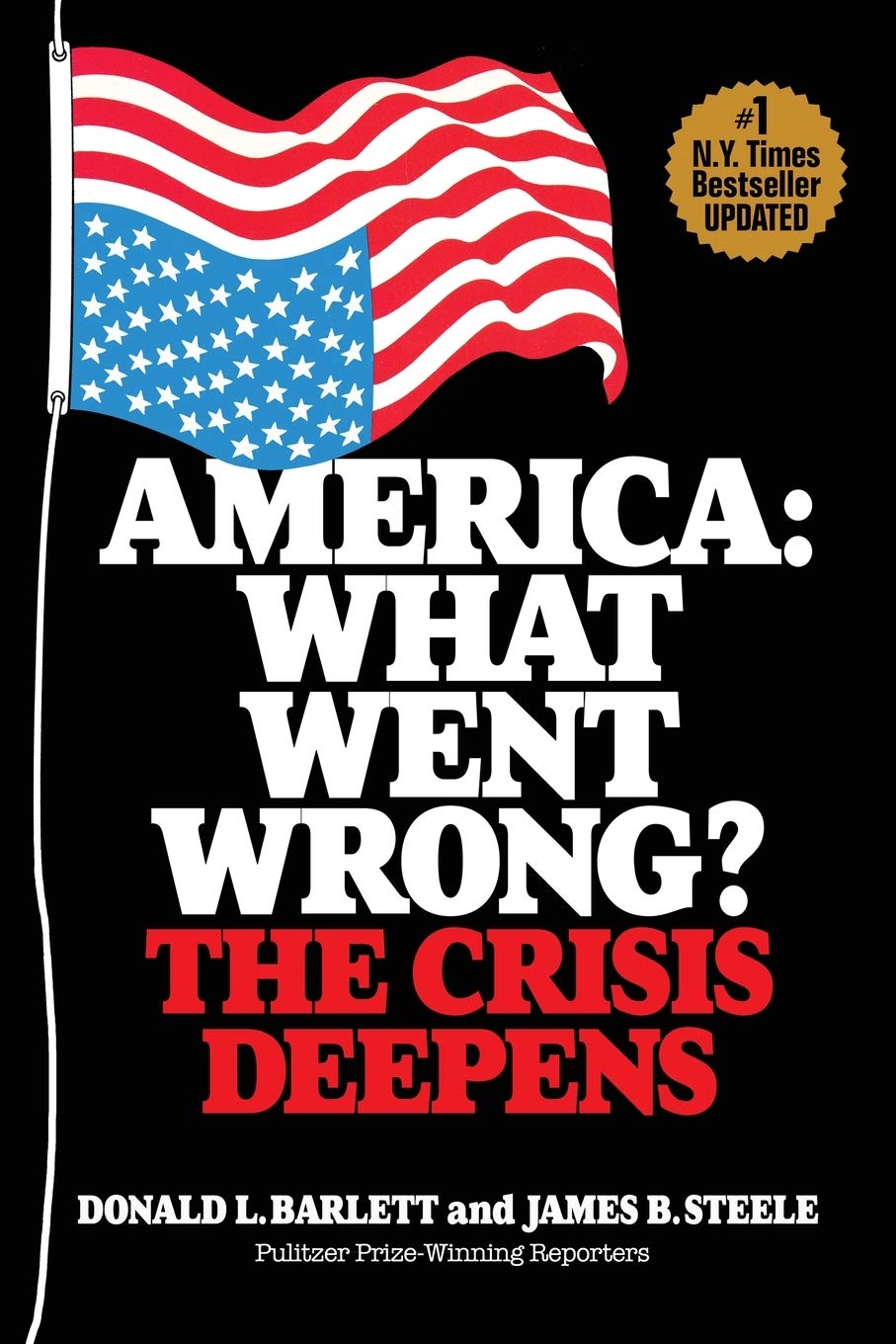
In 1992, when Pulitzer Prize winning investigative reporters, Donald L. Bartlett and James B. Steele, set out to first determine what had gone wrong with America’s promise for its people economically and socially they found troubling signs of pervasive inequality and the public sector weakened to a point where it was unable to craft new policies to address the problems. They documented the impacts on people’s lives with hard evidence. With the passage of time, they saw those trends worsening and set about to document a growing problem in their updated 2020 edition of their book, ‘America: What Went Wrong? The Crisis Deepens’. This portrayal finds an economy in which millions of Americans find their wages stagnant, their health care unaffordable and the prospect of an impoverished retirement. This no accident. America’s tax policy and indifference to many who have a weak political voice has brought us to this point. And recent events have only made matters worse and shone a bright light on these issues. Our guest, James Steele, explains how we got here over the course of the last four decades.

EP 387 Can You Believe in the Scientific Breakthroughs You Read About?

EP 387 Can You Believe in the Scientific Breakthroughs You Read About?

https://images-na.ssl-images-amazon.com/images/I/414ZOzxV%2BiL._SY445_QL70_ML2_.jpg

Daily we are bombarded with one scientific finding after another. How often have you quoted this or that finding to a friend and suggested that a change of behavior might be in order as a result? Stuart Ritchie, author of ‘Science Fictions’ suggests that you may want to curb your enthusiasm to insure that the study has not been tainted by fraud, bias, negligence or hype. Mr. Ritchie is a man of science and doesn’t fall in with the anti-science types who have loud megaphones these days on vaccines and climate change. He is concerned, however, that even science published in prestigious journals often turns out to be faulty after further review. It gives the layman much to ponder about what to believe. Aside from corporate directed science we need to be skeptical, like good scientists, that the purported findings have been as rigorously arrived at as we would have hoped.

EP 386 Health Care in America in the Wake of the Pandemic

EP 386 Health Care in America in the Wake of the Pandemic

With well publicized concern that a spike in the coronavirus might result in a possible buckling of our health care system in America, many are imagining the changes to get better systems in place to protect public health and insure access and quality to clinical services for more Americans. As a podcast focused on the future, we wanted to explore what this crisis may have taught us and what innovations tested in an emergency, like telemedicine and more coordination between different hospital systems, might become more commonplace going forward. And, of course, there’s always the issue of how do pay for the medicine Americans want. There is wide agreement by citizens that cost and service delivery are both in need of major overhaul. To discuss these issues with us is Arielle Kane, Director of Health Policy, for the Progressive Policy Institute.

EP 385 Climate Change Takes a Backseat to Other Crises and a Backhand From the Federal Government

EP 385 Climate Change Takes a Backseat to Other Crises and a Backhand From the Federal Government

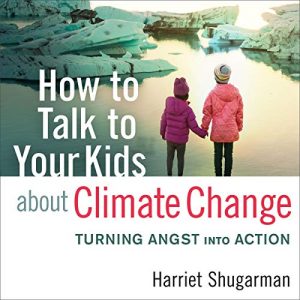
A recent headline in the New York Times indicates that the Trump Administration is reversing nearly one hundred environmental rules on issues relating to air pollution and emissions, drilling and extraction, water pollution, toxic substances and more. And this is after pulling out of the Paris Climate Accords and appointing a former coal industry lobbyist to head the Environmental Protection Agency. And while all of this has happened and climate change has been swept from view by other more immediate crises, like COVID-19 and racial inequities, still certain signs are positive. State and local governments, major businesses, and consumers are adapting life to the changing, and threatened, planet. Harriet Shugarman, executive director of ClimateMama and author of ‘How to Talk to Your Kids About Climate Change’ is hopeful that progress can be made, but urges that we bring children to a greater awareness of the issue now. Through her book and activism she’s attempting to do just that. We had a conversation with her about the challenges getting adults and children to focus on the fact that what is happening is not normal and is within our control to address in the age of the Anthropocene, when humans are responsible for the general health of the flora and fauna on this one planet. It’s a wake-up call that while this issue has receded in some people’s minds, it has not gone away.

EP 384 The Empty Throne Grows Dusty as America Sidelines Itself on the International Stage

EP 384 The Empty Throne Grows Dusty as America Sidelines Itself on the International Stage

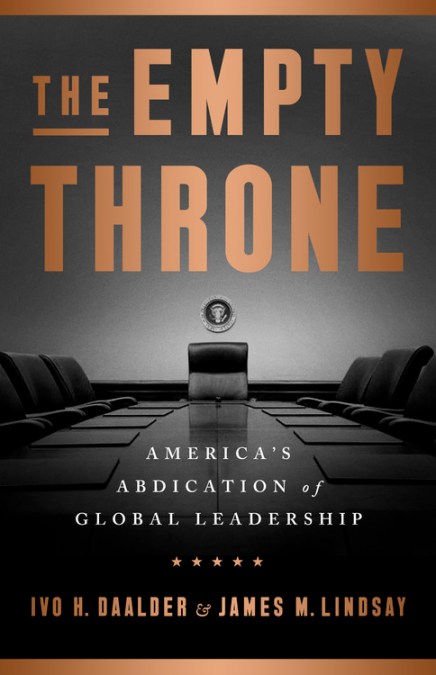
The rules-based world order that developed after World War II was not an accident of history. It resulted from America’s vigorous leadership. So for our allies in Europe, Asia and around the globe is was so puzzling that President Donald Trump would walk away from treaties and organizations America designed. While he blustered about America’s being taken for granted by our friends during the 2016 election, many felt that his early picks for Cabinet positions demonstrated that the notion of America alone was all talk. That was until he pulled out of the Trans-Pacific Partnership, the Paris climate accords, the Iran nuclear deal and recently his disputes with allies regarding the World Health Organization and how to handle the pandemic. A recent Politico headline screamed ‘Trump’s Europe Strategy: Nothing’. Ivo Daalder, who served as U.S. Ambassador to NATO under President Obama and co-author of ‘The Empty Throne’, along with James M. Lindsay, joins us to discuss what that vacuum means, who is trying to fill it and whether America can re-claim the mantle of the world’s most indispensable nation. And, if so, what lessons must we learn from overreach on America’s part after the end of the Cold War.

EP 383 Census 2020 and Its Impact on Elections Going Forward

EP 383 Census 2020 and Its Impact on Elections Going Forward

It is constitutionally required that we do an ‘actual enumeration’ of the residents of the United States every ten years on the 00’s. Well, it’s that time. And in the middle of a pandemic and a presidential election, we are being reminded of how challenging that process can be and yet how important it is. After all it was the GOP’s Operation RedMap, in the wake of the 2010 census, that masterfully, though of dubious legality, re-drew Congressional districts in key states that swung to their advantage even while losing the popular vote statewide. The notion of gerrymandering is alive and well in America. In 2020 Democrats have set up their own approach to monitoring the process state by state in an attempt to blunt the advantage Republicans gained in the recent past. How that all plays out will take time, but of more immediate concern is how delays in doing the census, because of the pandemic, will affect states and redistricting. Many states are up against deadlines codified in their Constitutions and laws. To sort out as best we can what could result in a legal and political tangle, we talk to Christopher Lamar of the Campaign Legal Center and Jeff Zalesin, who at the time of the recording was an attorney for the Campaign Legal Center and has since left that position

EP 382 A Soldier’s Disillusionment With Our Longest War

EP 382 A Soldier’s Disillusionment With Our Longest War

Before we engage in any war, Erik Edstrom asks us to imagine three visions: First, imagine your own death. Second, imagine war from ‘the other side’. Third, imagine what might have been if the war had never been fought. Through that lens and his own combat experience, Edstrom graphically depicts why in all his time in Afghanistan he never felt that he would possibly die for ‘something worth fighting for’. Provoking us to think whether America has gotten too comfortable venerating the military, without seriously examining its shortcomings and excesses, he suggests the Department of Defense may more aptly described as the Department of Offense. America’s indiscretions on the battlefield, and killing of non-combatants at a rate of 300 to 1 in response our losses on 9-11, begs in his view for a wholesale examination of our deployment of the military. In his book, ‘Un-American’, he describes his evolution from a young West Point graduate who didn’t think ‘our wars were self-perpetuating, self-defeating and immoral’ to a solider on the battlefield who came clearly to see the opposite. His descriptions of loss on all sides is graphic and disturbing, but highly revealing. We often only see war as something ‘over there’. He feels that the military’s greatest fear is that someone might do to us what we do to others. He strips away the Disneyification of the military and forces us to consider our recent choices to employ force around the world.

EP 381 The Science of Achieving Adulthood is Changing and Many Are Abandoned in the Transition

EP 381 The Science of Achieving Adulthood is Changing and Many Are Abandoned in the Transition

  In 2017, research showed that 4.5 million Americans between the ages of 16 and 24 were neither in school nor working.  Falling into that gap is a far different experience than the one enjoyed by more affluent and socially connected people that age who can take a ‘gap year’ between high school and college and explore numerous opportunities afforded to them by their families,  Like so many yawning social issues in our society, it begs for attention just as the science suggests that this period from the late teens to the early 20’s is still a time of brain maturation.  And given our low birth rates in this society, we don’t have a young person to waste if we are going to have a strong society in the future.  According to Anne Kim, the author of ‘Abandoned’, policymakers haven’t caught up with this group who are aging out of programs, if their education ends in high school, and may be emancipated in the eyes of the law, to a very uncertain existence. In the wake of the COVID-19 pandemic these young people may fall further behind in terms of their life chances. These may be the same young people who live in opportunity deserts, urban and rural, where few jobs exist in their communities.  While much focus has been placed in the recent period on the importance of early childhood education, little attention has been paid to this age cohort and their difficulties as they face the challenges of emerging adulthood.  It’s an important conversation.  Please listen in.

EP 380 The Hardhat Riot Marks Moment the GOP and America’s White Working Class Came Together

EP 380 The Hardhat Riot Marks Moment the GOP and America’s White Working Class Came Together

Sometimes riots come to define communities as you attach the name forever in your mind with the riots–like Watts, Attica, Detroit and others. And sometimes riots get lost in the long arc of American history. Few, however, are as little remembered and yet profoundly impactful as what occurred on May 8, 1970, in lower Manhattan. It was the day that David Paul Kuhn marks as the beginning of the end of the long relationship between America’s white working class and the Democratic Party. In his book, ‘The Hardhat Riot’, he describes the schism that tore liberalism apart and has had a mark on our politics to this day. In gripping detail, he takes us back to that harrowing day, when workers, in the shadow of the half-built Twin Towers, put down their tools and raised their voices signifying an emerging class conflict between two newly polarized Americas. In the wreckage was the Democratic Party’s electoral majorities, once so secure in the 20th century in America. What happened that day and in the electoral landslide for Richard Nixon in 1972 was a harbinger of the Reagan Revolution and Donald Trump’s surprising victory in 2016. Let’s delve into the history so we can understand the journey we are now part of, in another year of turmoil and conflict on our streets, in a presidential election year.